> ## Documentation Index
> Fetch the complete documentation index at: https://docs.onsomble.ai/llms.txt
> Use this file to discover all available pages before exploring further.
# Prompt Results
> See which questions mention your brand, how prominently it appears, and what the models actually said.
**Prompt Results** shows what happened for each question in your scan. Use it to move from a headline score to the prompts and AI responses behind that score.
For example, if Visibility has fallen, this page helps you find out whether your brand disappeared from a few important questions or from one particular model.
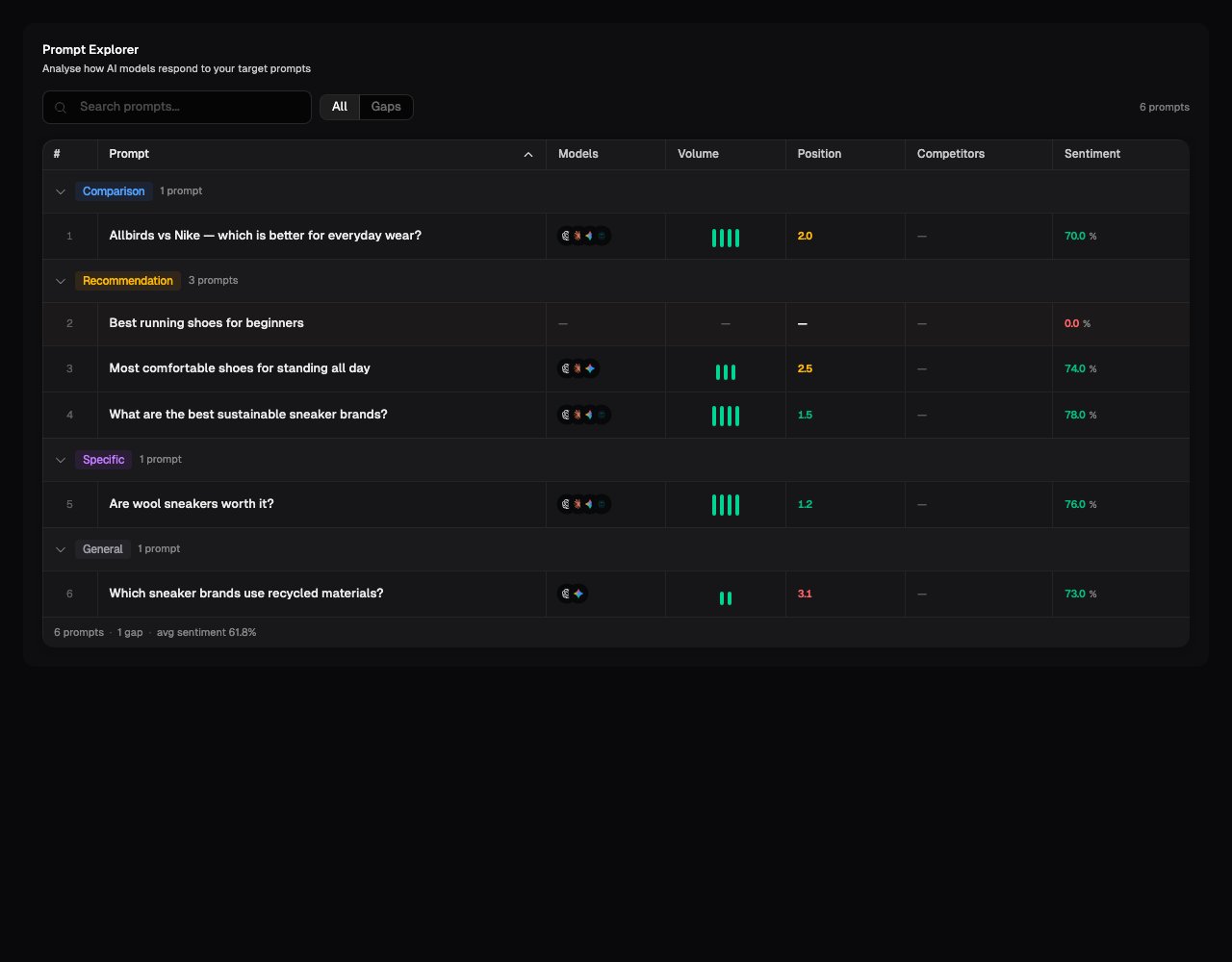 ## What the table shows
Each row is one prompt from your [Prompt Library](/scans/prompt-library). Its results are combined across the models and regions included in the current view.
See [Understanding metrics](/results/understanding-metrics#prompt-level-measurements) for the calculations and data limits behind the prompt-level values.
| Column | What it means | How to read it |
| --------------- | ------------------------------------------------------------------------------------- | ------------------------------------------------------------------------------------------------------------------------------------------------------------------ |
| **Models** | The models included in the result | Use the model filter when you want to compare them separately. |
| **Volume** | A visual summary of whether each model mentioned your brand and how early it appeared | Each bar represents a model. A green bar means the brand appeared; a taller bar means it appeared earlier. A muted or red bar means it was not mentioned. |
| **Position** | The brand's average place in the responses where a position could be measured | Lower is better: 1 means the brand appeared first. A dash means there was not enough data to calculate a position. |
| **Competitors** | The other tracked brands mentioned in responses to that prompt | A high count can show that the prompt is competitive, but it does not tell you whether every competitor was described favourably. |
| **Sentiment** | The average tone of the brand's mentions, on a 0 to 100 scale | Values above 50 indicate favourable language, 50 is neutral, and values below 50 indicate unfavourable language. A dash means there was not enough sentiment data. |
**Gaps** is a view of prompts where your brand was not mentioned. It is not a
separate score. Use it to find questions where competitors or other sources
appeared but your brand did not.
## Understanding changes
Where a change is shown, it compares the current result with the previous completed scan. The change is measured in points, not as a percentage increase.
For example, a move from 40 to 46 is an increase of **6 points**. It shows that the measured result changed; it does not prove what caused the change.
## Read the responses behind a prompt
Use the response or trend action beside a prompt to inspect its underlying results. Look for:
* **Absence:** If your brand is missing, note which alternatives are included and what they are known for.
* **Position:** Check whether your brand appears as a leading option or only as a passing mention.
* **Framing:** Compare the words used for your brand and its competitors. A mention can still be weak if it omits an important strength.
* **Inaccuracies:** Record outdated prices, products, locations, or claims that need correction.
* **Omissions:** Look for details that distinguish the business but are consistently missing from the answers.
The [References](/results/references) page can then help you see which observed sources may be shaping those answers. A source appearing there is useful evidence, but it does not prove that a specific source caused a specific response.
## A useful way to investigate a weak result
1. Filter to the model, region, or prompt type you care about.
2. Open a prompt with a missed mention, poor position, or negative sentiment.
3. Read several responses rather than relying on one example.
4. Compare the claims and sources used for your brand and its competitors.
5. Turn the repeated pattern into a specific action, then compare it with later scans.
Prompt Results reflects only the prompts, models, regions, and scan dates in
scope. It does not measure every question a customer could ask, and AI answers
can vary between runs.
## What's next
Review suggested actions based on patterns found in the scan.
Check whether your prompt set covers the questions that matter.
## What the table shows
Each row is one prompt from your [Prompt Library](/scans/prompt-library). Its results are combined across the models and regions included in the current view.
See [Understanding metrics](/results/understanding-metrics#prompt-level-measurements) for the calculations and data limits behind the prompt-level values.
| Column | What it means | How to read it |
| --------------- | ------------------------------------------------------------------------------------- | ------------------------------------------------------------------------------------------------------------------------------------------------------------------ |
| **Models** | The models included in the result | Use the model filter when you want to compare them separately. |
| **Volume** | A visual summary of whether each model mentioned your brand and how early it appeared | Each bar represents a model. A green bar means the brand appeared; a taller bar means it appeared earlier. A muted or red bar means it was not mentioned. |
| **Position** | The brand's average place in the responses where a position could be measured | Lower is better: 1 means the brand appeared first. A dash means there was not enough data to calculate a position. |
| **Competitors** | The other tracked brands mentioned in responses to that prompt | A high count can show that the prompt is competitive, but it does not tell you whether every competitor was described favourably. |
| **Sentiment** | The average tone of the brand's mentions, on a 0 to 100 scale | Values above 50 indicate favourable language, 50 is neutral, and values below 50 indicate unfavourable language. A dash means there was not enough sentiment data. |
**Gaps** is a view of prompts where your brand was not mentioned. It is not a
separate score. Use it to find questions where competitors or other sources
appeared but your brand did not.
## Understanding changes
Where a change is shown, it compares the current result with the previous completed scan. The change is measured in points, not as a percentage increase.
For example, a move from 40 to 46 is an increase of **6 points**. It shows that the measured result changed; it does not prove what caused the change.
## Read the responses behind a prompt
Use the response or trend action beside a prompt to inspect its underlying results. Look for:
* **Absence:** If your brand is missing, note which alternatives are included and what they are known for.
* **Position:** Check whether your brand appears as a leading option or only as a passing mention.
* **Framing:** Compare the words used for your brand and its competitors. A mention can still be weak if it omits an important strength.
* **Inaccuracies:** Record outdated prices, products, locations, or claims that need correction.
* **Omissions:** Look for details that distinguish the business but are consistently missing from the answers.
The [References](/results/references) page can then help you see which observed sources may be shaping those answers. A source appearing there is useful evidence, but it does not prove that a specific source caused a specific response.
## A useful way to investigate a weak result
1. Filter to the model, region, or prompt type you care about.
2. Open a prompt with a missed mention, poor position, or negative sentiment.
3. Read several responses rather than relying on one example.
4. Compare the claims and sources used for your brand and its competitors.
5. Turn the repeated pattern into a specific action, then compare it with later scans.
Prompt Results reflects only the prompts, models, regions, and scan dates in
scope. It does not measure every question a customer could ask, and AI answers
can vary between runs.
## What's next
Review suggested actions based on patterns found in the scan.
Check whether your prompt set covers the questions that matter.