

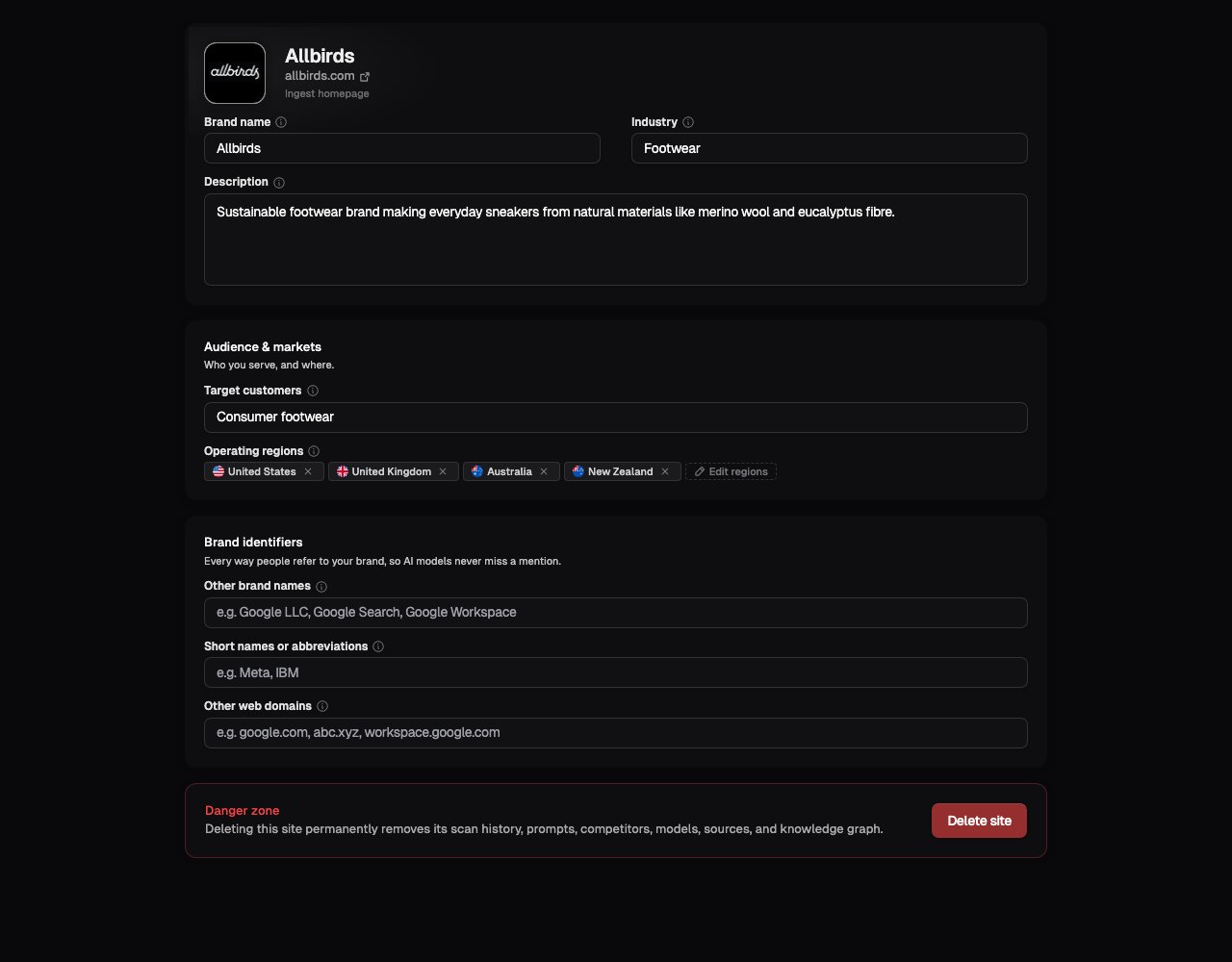
How the first profile is created
Site creation starts with a public website URL. Onsomble reads available information about what the business does, who it serves, and where it operates. It then presents an editable profile before you confirm the Site. The initial profile contains the business name, industry, description, target customers, and operating regions. During first account setup, confirming it continues to competitor and prompt configuration. When you add another Site later, confirming it creates the Site and opens its Overview. If the wrong business appears, use Not your site? or Wrong site? to return to URL entry. This discards the draft so you can research a different website.The business profile
Open Site Settings to review or change:- Brand name and Industry: the business identity used in the Site and its scan configuration.
- Target customers and Operating regions: who the business serves and where it operates. Select Edit regions to search for and choose markets.
- Description: a short account of what the business does.
Brand identifiers: helping Onsomble spot your brand
AI assistants do not always call your business by its exact name. They might use a shorter version, an old name, or a sister website. A scan can only count a mention when Onsomble recognises that the AI is talking about you, so these fields tell it every way your brand shows up. The better they are filled in, the more your Visibility, Sentiment, and Share of Voice reflect what is really being said about you. There are three fields, and each one is for a different kind of name:- Other brand names: other full names that always mean your business, like a spelled-out version, an old name, or a product line people treat as the brand. Onsomble counts every one of these as a mention of you. For example, a company now called “Meta” might add its former name “Facebook”.
- Short names or abbreviations: short names or initials that could also mean something else, like a stock ticker, or a brand name that is also an everyday word (a clothing label called “Gap”, for instance). Onsomble only counts these when the rest of the sentence makes it clear the AI means you. That way a common word is not counted as your brand every single time it appears. This is why short names are kept separate from full names.
- Other web domains: other websites your business owns. When an AI assistant points to one of them as a source, Onsomble knows that source is yours, and it shows up in References. Your main website is already covered, so only add the extras here.
Saving profile changes
Profile fields save when you finish editing them. A status in each section’s header shows whether the change is saving, saved, or failed. Changing the profile does not delete completed scans. Brand names and aliases can affect how Onsomble identifies the business in future scan processing. Other context fields can affect competitor and prompt suggestions, so review the profile before configuring the next scan.Ingesting or refreshing the homepage
The Site domain appears at the top of Site Settings. Select Ingest homepage to store its current public content. If the homepage has already been ingested, use Refresh homepage content to read it again. Refreshing homepage content does not edit the business profile or start a scan. Review the profile separately if the business name, audience, services, or operating regions have changed.If website research fails
Use the message shown during Site creation to correct the URL and try again. These checks cover the most common causes:The URL is not accepted
The URL is not accepted
Enter the public root URL, including the domain. Check for a spelling error or an incomplete address before retrying.
The website is not publicly accessible
The website is not publicly accessible
Open the URL in a private browser window. Onsomble cannot research pages that
require a login. Website security or crawler protection may also prevent
access even when the page opens for you.
The profile is incomplete
The profile is incomplete
A small or outdated website may produce a limited draft. Correct the available fields before creating the Site, then add any brand aliases from Site Settings.
Keeping the profile current
Update the profile when the business changes its name, audience, services, domains, or operating regions. Completed scans remain in the Site’s history, but future scans use the current configuration. Keep a note of material profile changes when comparing results across time.What’s next
Managing multiple Sites
Move between Sites, update their names, and delete a Site when required.
How scans work
See how prompts, models, regions, and competitors form a scan.